
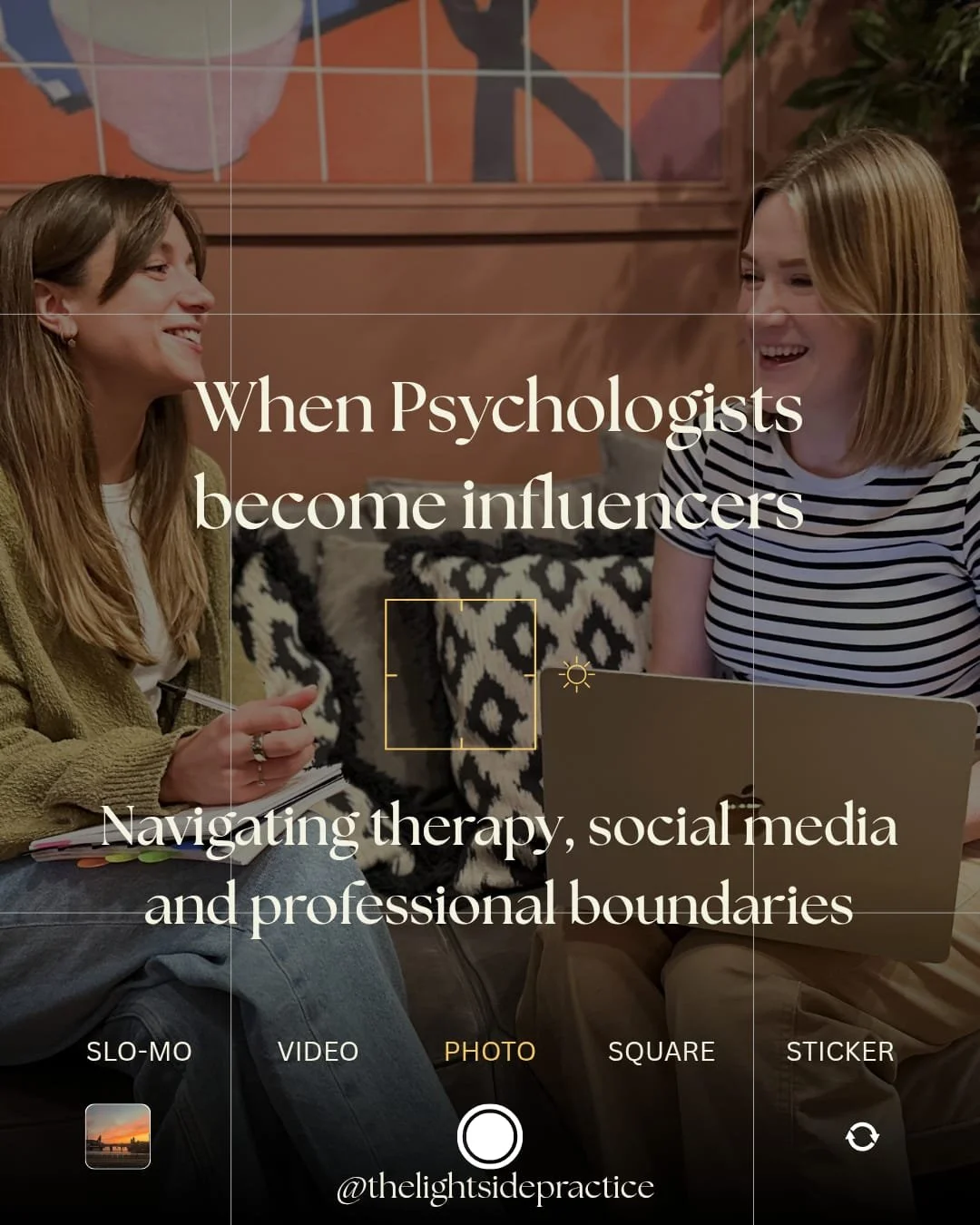
When Psychologists become influencers: Navigating therapy, social media and professional boundaries
As a clinical psychologist who started her doctoral training in 2018, I sometimes find myself looking back and wondering just how much things have changed, and how quickly the profession continues to evolve.
I have a particularly vivid memory from my doctoral training, of the course introducing its first ever lecture on something along the lines of “Therapy Online: The Use of Zoom.” At the time, it felt novel. There were lots of different opinions, plenty of uncertainty, and a sense that this was a new and somewhat unusual way of delivering therapy. Zoom was framed as something that might be particularly useful in one-off circumstances: perhaps someone living in the Highlands of Scotland, in the middle of nowhere, who couldn't easily access a therapist locally, or someone with a physical or mental health condition that made attending therapy in person difficult. There was a lot of discussion about what might be lost by moving therapy online e.g. What does it mean for the therapeutic relationship? What might feel different? What are the boundaries?
Then came one of the more practical questions, which now feels quite comical - “what do you do about your virtual background?”
At the time, this felt like a particularly interesting new consideration. Suddenly, you could be bringing a client into your home. They might see your bookshelves, your kitchen, your artwork, your dog, your mess... or simply the room you happened to be sitting in. The boundaries between the professional world and the rest of your life could become a little more blurred.
This was particularly interesting given how strongly professional boundaries and neutrality are instilled throughout clinical psychology training. We are taught to think carefully about what we share, what we don't share, and what our personal presence might bring into the therapeutic space. There are, of course, lots of debates around this within psychology, but there was certainly a strong sense during my training that the psychologist's personal life was separate from the therapeutic relationship.
Fast forward to 2026
Social media accounts are everywhere. Psychologists and therapists are sharing “day in the life” videos, memes from their clinical practice, snippets of their working days, their offices, their routines, and increasingly, themselves. There is much more of a sense of the person behind the professional.
And, of course, The Light Side Practice is part of this - we have our own social media account, our website, and this blog. Part of the reason I'm sitting here writing this is because it is something we are navigating ourselves. My co-founder and I have had many conversations about how much of ourselves we should and shouldn't show on social media.
There is an interesting clash between some of the core teachings of our profession (neutrality, boundaries and thoughtful self-disclosure) and the growing expectation that people want to know their therapists. They want to see more of your life, understand who you are and feel that they can relate to you.
Social media is very good at rewarding this. Post a piece of text and you might get minimal interaction. Put a video of your face on screen and, suddenly, people engage. There isn't necessarily a right or wrong way of doing this, but it is an interesting observation about the environment in which we now practise. As our world becomes increasingly shaped by social media, efficiency and constant access to other people's lives, the boundaries around what is considered private and what is considered shareable seem to be shifting. We are increasingly used to seeing snippets of other people's lives and, in many ways, being part of them without actually being there - sharing locations with friends, having non-stop conversations through Snapchat and WhatsApp, and having increasingly immediate access to one another.
I wonder whether therapy is inevitably being pulled into this shift too?
I've had friends talk about being in therapy and having access to their therapist through WhatsApp, or being able to have regular on-demand phone calls between sessions. Again, there isn’t necessarily a right or wrong approach around this - different models of therapy will work for different people, and there are certainly circumstances where flexibility and accessibility can be incredibly helpful. However, it does make me wonder how our expectations of therapy are changing.
What does it mean to have a therapist who is increasingly visible online? Where does the therapist end and the person begin? And how much do we now expect to know about the people who support us?
The psychologist as a brand
There is another layer to this conversation too. Social media is now deeply intertwined with how many businesses grow. We regularly have conversations with friends who want to do something really connected to their values perhaps become a hiking instructor, open a coffee shop and create a local community, or start a creative business. But, almost inevitably, the conversation comes back to social media e.g. you'll need social media, you'll need to make reels, you'll need to build a following.
For many people, that can feel uncomfortable. Not everyone wants their personal life to become part of their business, not everyone wants to perform their work online, and not everyone wants to become a content creator simply to make their business visible.
Psychology isn't immune to this, but there is a particular tension here because psychologists aren't simply selling a product. We are offering a relationship, expertise and a professional service that relies heavily on trust. Our training places a lot of emphasis on boundaries, neutrality, self-disclosure and the careful use of the therapeutic relationship. There are also important differences between the training and professional frameworks of clinical psychologists, counselling psychologists, counsellors and psychotherapists, including how boundaries, neutrality and self-disclosure are approached, but perhaps we'll save that for another blog!
So… this is where we find ourselves a little stuck.
There is now so much mental health information, advice and support available online. Some of it comes from qualified clinicians and is grounded in psychological evidence, and some of it doesn't. I don't think that means that people without psychology qualifications shouldn't be talking about mental health, far from it – lived experience is invaluable, and some of the most helpful conversations online come from people sharing their own experiences and perspectives.
I do, however, think it matters where information is coming from, particularly when we're talking about mental health. There is a difference between sharing your own experience, sharing a helpful idea, and giving advice that someone might take as psychological fact. When someone is struggling, that distinction can be difficult to navigate, particularly when something is delivered confidently, feels very relatable and has thousands of likes or followers behind it.
For me, this is where there is an important place for qualified clinical psychologists and other appropriately trained clinicians online. We have something important to contribute to these conversations, and perhaps a responsibility to make good psychological knowledge more accessible. I have lots of friends and colleagues providing amazing work online. People are sharing thoughtful, evidence-based psychological information, challenging stigma, talking openly about mental health and making psychology feel more accessible to people who might never otherwise come across it. Some of the accounts I follow have introduced me to ideas, research and conversations that I've found genuinely useful, both personally and professionally.
For some people, social media might be their first point of contact with psychology. It can make something that can feel quite intimidating feel a little more familiar and approachable. It can create communities and conversations that might not otherwise exist, and reach people who perhaps aren't ready, able or interested in accessing traditional therapy.
This is a big part of why we want to be online at the Light Side Practice. Making psychological knowledge and useful tools as accessible as possible is one of our core values. We don't believe that good psychological information should only be available to people who can afford 1:1 therapy. We want to share ideas, tools and evidence-based psychological knowledge that people can access freely, alongside the 1:1 therapy and other paid offerings within the practice.
This is where the tension sits for us
Social media can be incredibly useful, and there are psychologists and therapists doing things online that I really admire. At the same time, it is changing the way we think about what a psychologist is, how much of ourselves we share, and what people come to expect from us. I find myself wondering what we might lose if being visible, relatable and engaging online becomes increasingly intertwined with being a successful psychologist.
We don't have the answer at the Light Side Practice. We're certainly part of the social media world, and we can see the value in it, but we don't want to simply add to the noise or feel that we have to become influencers in order to be visible.
So... we are observing, thinking, conversing and navigating our way through it.
My co-founder and I talk about this a lot. We question what we're doing, what we're sharing and why we're sharing it. We're trying to work out how much of ourselves we want people to see, while also recognising that being visible can be part of making a practice accessible. For now, we're navigating our way through as best we can, trying to find a way of using social media that feels aligned with our values, our training and the kind of practice we want the Light Side to be.
We are mindful that from a substantial body of research (e.g. Flückiger, Wampold & Horvath, 2018), the therapeutic alliance is consistently associated with better therapy outcomes. So perhaps there is something helpful about a client being able to get a sense of who their therapist is before they even walk through the door, maybe that familiarity helps them feel more comfortable or connected. But equally, we all curate ourselves to some extent online. If someone arrives feeling like they already know you, do they actually know you, or the version of you that you've chosen to share? Could that familiarity help build the relationship, or could it create expectations that don't quite fit with the person they meet in the therapy room?
I really hope this article has captured some of the complexity of this conversation. I suppose, more than anything, I'd love for this to be a space to hear different experiences, perspectives and thoughts, rather than feeling that there is one “right” way of doing things. If you are a trainee clinical psychologist, we are really curious about whether these conversations are happening in training now, and whether the way we think about professional boundaries, self-disclosure and being a psychologist online is changing too.
Because when I think back to that lecture about Zoom, it feels quite funny now that something as simple as “what do you do about your virtual background?” felt like such a big question. The question now seems much bigger. It's about how much of you they see before they've even met you, what they know about you, how accessible you are, and how much of your professional identity now exists online.
Watch this space as to whether you’ll see more of us online! But either way, we'll certainly still be here, trying to make psychology accessible, thoughtful and human, while working out where the boundaries sit along the way.
Author: Dr Hannah Meechan, Clinical Psychologist
References:
Flückiger C, Del Re AC, Wampold BE, Horvath AO (2018), The alliance in adult psychotherapy: A meta-analytic synthesis. Psychotherapy (Chic).
