
Why Change Can Feel Exciting, Terrifying & Completely Overwhelming, All At Once
Even when you rationally understand why change feels hard, it doesn't necessarily make it any easier when you're right in the middle of it.
As a psychologist, a big part of my day-to-day work is about change, including the change we choose, the change that chooses us, and how we cope with both. This year in particular I’ve experienced a lot of change both professionally and in my personal life, which has given me plenty of opportunities to notice my own responses to uncertainty, newness and things that are outside of my control.
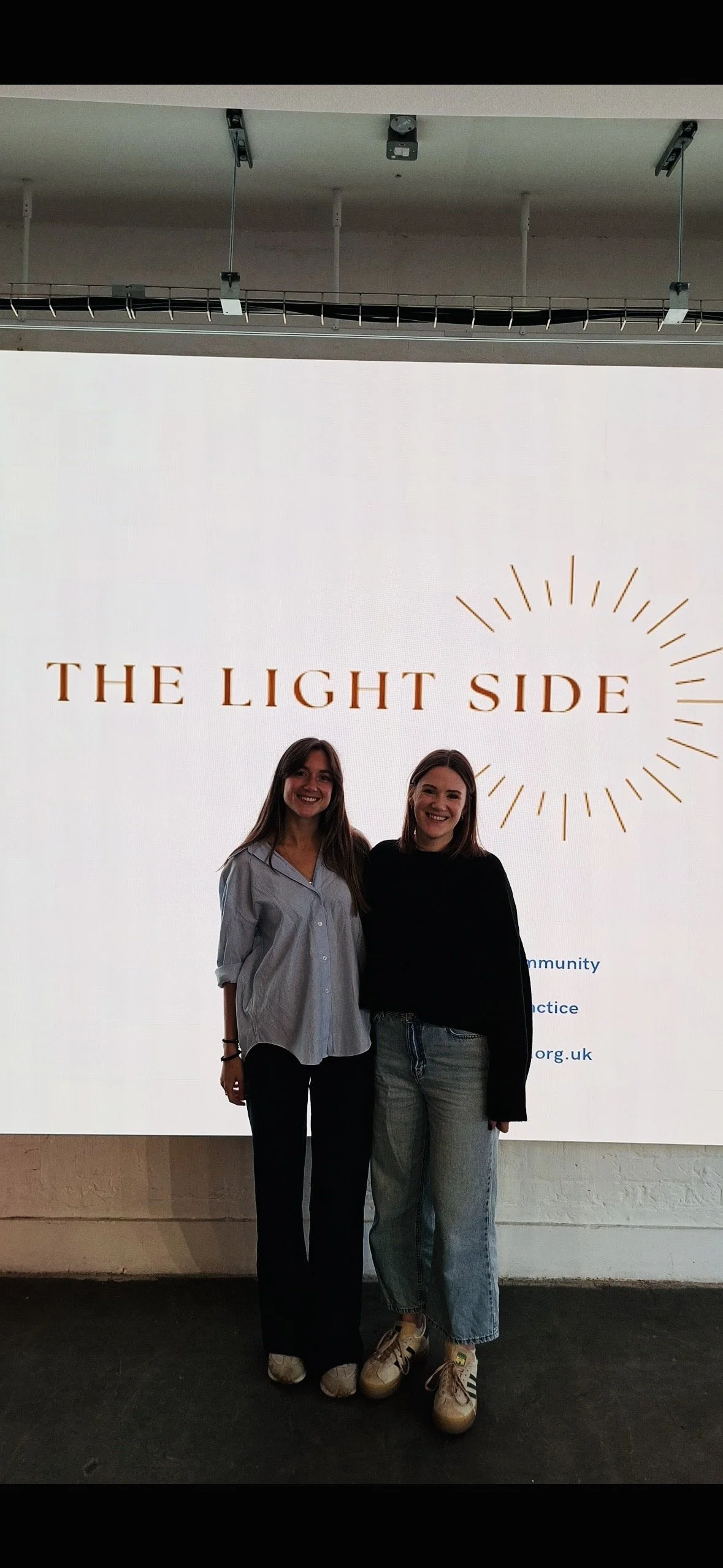
Back in 2022, my Light Side co-founder, Hannah, and I met for brunch and talked about an idea: opening a practice built around making therapy more accessible. We named it, talked about what it could look like, and then we quietly parked the idea. At the time, we were safe in our NHS jobs and didn't really have the headspace to make the jump. Fast forward to 2025 and another brunch, the same conversation, except this time we were ready to actually do it.
What followed was a year of lots of smaller decisions building into two big ones. I left the four-day-a-week NHS job I'd held for several years, moving three days a week into The Light Side alongside my co-founder, and two days a week into a new NHS role elsewhere.
These changes turned out to be hard in very different ways.
At The Light Side, I already had Hannah. I had someone beside me, so the change wasn't really about relationships shifting or wondering where I belonged. My fear was much more about my own competence. That nagging internal voice questioning ‘Is this a good idea? What if it doesn’t work out? What if I’m not good enough or I don’t know how to do it?’
In my new NHS role, it was almost the opposite. The skills were familiar, but I was the new person again. I had to work out where I fitted into a team I didn't yet know and get used to being the person who didn't know how things worked.
There were some high points across both including launching the practice, running our first community event, becoming an official company, meeting new people and just generally watching something we'd talked about over the years actually become real.
But there was also a fair amount of quiet anxiety and a self-critical voice that liked to remind me, "Other people do this all the time and they're fine. Why are you finding it hard?"
When I step back, I know that finding these changes hard was completely understandable. When we're uncertain, our brains can try to fill in the gaps. They imagine what might go wrong, run through worst-case scenarios and look for ways to keep us safe. But knowing that doesn't always stop you feeling it.
The body doesn't always know the difference
There's a reasonably well-established idea in psychology that the physical sensations of excitement and anxiety can look really similar. They can both prompt a faster heart rate, a flutter in your stomach, restlessness, and lots of thoughts focusing on ‘what ifs’ or potential scenarios.
The thing that makes the difference between feeling anxious, excited or relatively neutral isn't necessarily the sensation itself, but the meaning we give it.
I've found this helpful when thinking about my own experience of change. When I feel that fluttery feeling in my stomach, the racing thoughts, the restless energy, sometimes I interpret those sensations as something is wrong. At other times, I recognise them as excitement.
In compassion focused therapy, we often think about three systems that influence how we feel. There's the threat system, which scans for danger and can tip into anxiety and self-criticism; the drive system, which pushes us towards reward, achievement and momentum; and the soothe system, which helps us experience safety, calm and self-compassion.
Big changes can activate the threat and drive systems at the same time. Which perhaps explains why you can feel completely exhilarated and completely terrified within the same five minutes.
I noticed this quite a lot over the last year. The voice telling me, "Other people do this all the time and they're fine, why are you finding it hard?" was my threat system looking for evidence that I wasn't safe. My mind and body had registered uncertainty and were trying to make sense of it, often by assuming the worst.
But that very same restless energy could also move me forwards. It helped me keep going, chase the next milestone and feel genuinely excited about what Hannah and I were building. The feeling hadn't necessarily changed. What changed was the meaning I was making of it.
I think that's important because we can sometimes talk about emotions as though they're choices. How many times have you heard, or seen on social media, "Try to be excited," "Don't be anxious," "Be confident," "Think positively"?
Although usually said with good intentions, advice like this doesn't acknowledge that our bodies don't always work that neatly. We don't necessarily get to choose which feeling arrives, or when.
What we can do is become a little more curious about what's happening. Is this my threat system telling me I need to be careful? Is my drive system pushing me towards something that matters to me? Or perhaps I need to bring in a bit more of that soothe system and a chance to slow down, feel safe and remind myself that I don't have to have everything figured out just yet.
I don't always get that right. But when I can stay curious about what's happening, it often feels much kinder than trying to convince myself that change should only feel exciting.
What are we really responding to?
I've come to think that some of the difficulty that comes with change isn't actually about the change itself. It's about what we're being asked to let go of.
Even when we choose a change and are genuinely excited about what comes next, we're usually leaving something behind. It might be a routine, an identity, a sense of belonging, a level of certainty, or simply a version of life that we'd become comfortable with.
I noticed this in my own experience of leaving a team I'd known well for several years. On paper, it was a professional decision. I was moving into something new that I was excited about. But underneath that, I was also leaving behind people I’d built close relationships with, routines that were familiar and a sense of belonging that I hadn't needed to think about for a really long time. I knew part of me would miss the job and my team, but I don't think I'd fully appreciated just how much that would be part of the change at the time.
The threat system isn't particularly good at distinguishing between something that is genuinely dangerous and something that simply takes away what is familiar. Loss can feel like loss, even when we've chosen it. Even when we're excited about what comes next, and even when we know we've made the right decision.
Nobody really warns you that starting something exciting can come with its own quiet grief for what's being left behind. Perhaps that's why change doesn't always feel the way we expect it to. We might imagine that making the right decision will bring relief, excitement or momentum, and then feel confused when sadness, doubt or a longing for how things used to be turns up alongside it.
Then there's also uncertainty to contend with. Our brains tend to like things they can predict. Given the choice, we can find ourselves drawn towards something difficult but familiar rather than something unfamiliar that could turn out really well. Not necessarily because the familiar is better, but because we know what we're dealing with.
It's part of the reason someone might stay in a job or a relationship they know isn't right rather than risk finding out what could come next. Certainty, even uncomfortable certainty, can be very persuasive.
Again, I don't think that's a flaw in anyone's character. It's the threat system doing what it evolved to do; treating the unfamiliar as a possible risk until it knows otherwise.
For me, understanding this has helped me make a little more sense of why change can feel difficult even when, logically, I know it's the right decision. Sometimes we're not just adjusting to what's coming next. We're also saying goodbye to something we've known for a long time.
Where does that leave us?
I don't think the answer is to try to talk ourselves into only feeling excited, or to push through the scared or overwhelmed parts until they eventually quieten down. If anything, that can add another layer of pressure, because now we're not only managing the change itself; we're managing how we think we're supposed to feel about it.
And sometimes that's just the drive system trying to out-muscle the threat system. In my experience, that doesn't tend to leave me feeling particularly calm. It leaves me overwhelmed and exhausted.
It's also worth saying that not all change is chosen, and not all change is big.
Some of it is small and constant, such as a new routine, a change in schedule or a different commute. Some of it lands on us without our permission, like redundancy, a relationship ending, loss, or something else we never would have chosen.
When change isn't chosen, the drive system doesn't always show up to balance things out in the way it did for me. There might be no exciting new goal on the other side, just uncertainty and the need to find a way through it. And even when change is chosen, we won't all experience it in the same way. Things like our previous experiences, how sensitive our threat systems are, and our individual neurotypes can all shape how change lands for us. So, the mix of excitement and fear won't be the same for everyone, or for every kind of change, and I think it's important not to assume that it should be.
What has helped me more, is deliberately bringing in that third system: soothe. For me, that starts with noticing that change is having an impact. Actually stopping to recognise the thoughts and feelings that are there, rather than automatically pushing through them and pretending everything is fine.
From there, it depends on what I need. Sometimes it's talking things through with friends, colleagues or in clinical supervision. Saying the thoughts out loud can make them feel much more manageable than carrying them around in my own head.
Sometimes it's recognising that I need a break and actually giving myself permission to switch off from work. And sometimes it's reminding myself that feeling uncertain doesn't necessarily mean I've made the wrong decision. There isn't a one-size-fits-all answer. Change lands differently for different people, and differently for the same person at different points in their life.
Four years on from that first brunch, we're still somewhere between anxiety and excitement at times. The same is true in my new NHS role. I imagine that, over time, familiarity will grow and, without even noticing it, these changes will start to feel like the new normal.
All of this to say, if change feels complicated, you're not doing it wrong. You can be excited about what comes next and still miss what you're leaving behind. You can know you've made the right decision and still feel uncertain. You can feel anxious and excited at the same time.
I think the aim isn't to make change feel easy. I think it’s more about learning to become a little more comfortable knowing that excitement, fear, grief, uncertainty and hope can all have a place in the same story.
Author: Dr Catherine Bryan, Clinical Psychologist